Max Eckard
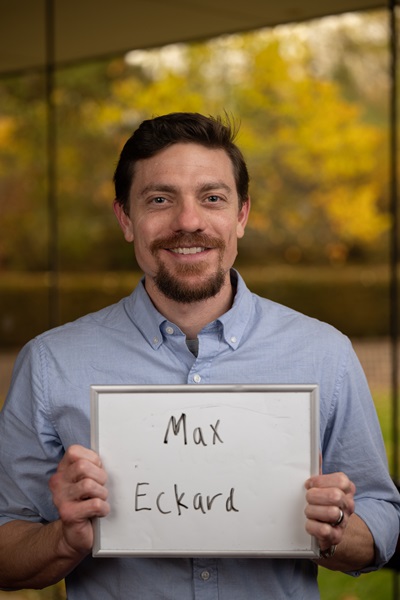
Photo credit: Leisa Thompson
Associate Director for Curation at the Bentley Historical Library
I'm Max Eckard, Associate Director for Curation at the University of Michigan Bentley Historical Library .
Table of Contents
About
As head of the Bentley's Curation Team, represents the team on the Bentley Leadership Team and leads the Bentley's holistic approach to curating archives of all genres and formats.
Provides leadership and supervision for those who oversee the processing and collections management programs (including conservation), digitization program, born-digital curation activities, web and social media archives, and associated infrastructure at the Bentley. In this role, provides strategic vision for the development, maintenance, and integration of our technical ecosystem, which includes Aeon, ArchivesSpace, Archivematica, Archive-It, DSpace, Kaltura, Fishrappr, and other platforms. Works closely with the Curation Team to support cultural competency efforts within the team and individuals, the creation and reuse of metadata, and the introduction of more efficient workflows through technical innovation. To achieve these goals, serves as the Bentley's primary liaison to the U-M Library’s Library Information Technology (LIT) group, to establish clear and consistent communications and advance the creation and enhancement of digital collections. Is the Bentley’s primary onsite coordinator at the Bentley’s North Campus Research Complex location.
Portfolio
Essays (Blog Posts) and Talks
Link to Essays (Blog Posts) and Talks .
Books

Take a peak inside Making Your Tools Work for You !
Archivists make use of many different tools and systems in their day-to-day work, all of which cover a wide range of functions in the big, bold (and, of course, sometimes difficult!) archival enterprise: research request and workflow management, archival information management, digital preservation, web archiving, digital repositories, and more. These tools necessarily specialize in one function or another, but none of them do it all, and managing so many resources can become overwhelming. The good news--at least when it comes to technology--is that... many systems are designed to connect with one another, and systems integration can support a variety of archival needs, creating efficient workflows from accession to ingest to access. Weaving together both theory and reflective practice, Making Your Tools Work for You gives an overview of the what, why, and how of systems integration for archives and digital libraries. Using examples from his work at the Bentley Historical Library as well as others' work in the field, Max Eckard outlines: how to design an integrated technical ecosystem; how to select systems capable of "playing nicely" with others; various integration methodologies to get systems talking to one another; tips for starting a systems integration project; and ways to clean, reconcile, program, and ultimately support data and metadata on the move. Whether designing integration from the ground up or taking steps to improve upon current systems, Making Your Tools Work for You is a comprehensive manual that will help readers adapt and apply these ideas to set up archives and digital libraries for success.
And it's been reviewed...
- Memory, Lindsey. "Review of Making Your Tools Work for You: Building and Review of Making Your Tools Work for You: Building and Maintaining an Integrated Technical Ecosystem for Digital Archives and Libraries ," Journal of Western Archives 13, no. 1 (2022)
- Leimkuehler, Ryan. "Review of Making Your Tools Work for You: Building and Review of Making Your Tools Work for You: Building and Maintaining an Integrated Technical Ecosystem for Digital Archives and Libraries ," Journal of Contemporary Archival Studies 10 (2023)
- Howard, Rachel I. "Making Your Tools Work for You: Building and Maintaining an Integrated Technical Ecosystem for Digital Archives and Libraries. By Max Eckard. [Review] ," Archival Issues 42, no. 1 (2023)
Peer-Reviewed Articles
- Eckard, Max, Elizabeth Gadelha, and Mike Shallcross. "Level Up! Lessons Learned from Six Years of Collaborative Technical Skills Development ," American Archivist 85, no. 2 (2022): 402-442.
- Eckard, Max and Dallas Pillen. "The Impact of the Shift to Cloud Computing on Digital Recordkeeping Practices at the University of Michigan Bentley Historical Library ," Archival Science (2022).
- Eckard, Max and Dallas Pillen. "Streamlining Digital Archival Workflows at the Bentley Historical Library ," Journal of Digital Media Management 6, no. 1 (2017): 65-77.
- Beaubien, Sarah and Max Eckard. "Addressing Faculty Publishing Concerns with Open Access Journal Quality Indicators ," Journal of Librarianship and Scholarly Communication 2, no. 2 (2014).
- Eckard, Max, Ashley Rosener, and Lindy Scripps-Hoekstra. "Factors that Increase the Probability of a Successful Academic Library Job Search ," The Journal of Academic Librarianship 40, no. 2 (2014): 1047-115.
[Past] Society of American Archivists (SAA) Digital Archives Specialist (DAS) Courses

The digital curation "ecosystem" is made up of any number of tools and systems that perform small, discrete tasks, cover particular format groups or functional areas of models like the Open Archival Information System (OAIS) Reference Model, and that even claim, at least, to be more or less comprehensive. This ecosystem is in a constant state of flux, and digital archivists are responsible for stewarding more and more--and more complex--digital content. Despite our wish for a "silver bullet," all of these tools necessarily specialize in one function or another, and none of them do it all. Managing such a high number of what are effectively silos of information and resources, especially the handoffs of data and metadata between them to support archival workflows, can be overwhelming. The good news, at least when it comes to technology, is that... many systems these days are designed to connect with one another, and systems integration can "knit" disparate systems together to support a wide variety of archival needs, creating efficient workflows from accession to ingest to access. In this course, you can expect an overview of the what, why, and how of systems integration and its role in "knitting" disparate systems together to support a wide variety of workflows in the archival enterprise. If you're starting from scratch, it will help you design your integrated technical ecosystem and choose tools and systems to comprise it that "play nicely" with others. This will include deeper dives into technologies like common metadata standards and application programming interfaces (APIs), as well as data interoperability protocols and other methodologies that get systems to "talk" to one another, as well as numerous real-world examples of systems integration "in the wild" to inspire you. If you're starting from an existing workflow that makes use of siloed systems, this course will help you make better use of the affordances of technology to get those systems to work together, better. The last module will be devoted to exploring issues at the intersection of archives and technology.
Computer Programs
Encoding Reparative Description(with Ella Li, Gideon Goodrich, and Jesse Johnston): This repository contains code related to the "Encoding Reparative Description" project, which began in 2023 with a team of researchers at the University of Michigan School of Information, the Bentley Historical Library, and the University of Michigan's Humanities Collaboratory.DAPPr: DSpace API Python Programming resource (DAPPr) is a Python client to communicate with a remote DSpace installation using its backend Application Programming Interface (API).BAroQUe(with Dallas Pillen, Hyeeyoung Kim, Liz Gadelha, Maryse Lundering-Timpano, Matt Adair, Melissa Hernández-Durán and Tim Baron): The Bentley Audiovisual Quality control Utility (BAroQUe) is a Python 3-based Command Line Interface (CLI) executable primarily intended for in-house use. It performs Quality Control (QC)--with microservices to validate directory and file naming structure, METS XML and WAV BEXT chunks--for audio digitized by vendors according to Bentley specifications.AVATAR: The Bentley A/V dAtabase To ARchivesspace (AVATAR) creates or updates ArchivesSpace collection-level and archival as well as digital object elements using data output from the A/V Database.
Curriculum Vitae (CV)
Link to Curriculum Vitae (CV) .
Contact Information
| Contact Information | |
|---|---|
| eckardm at umich dot edu | |
| (734) 763-7518 | |
| eckardm | |
| max-eckard-81009b45 |
P.S. I am also really into karate. And a few times I have given sermons... And once I did a Moth StorySLAM.