Jonah as Story (Sermon on Jonah [Excerpts])
On Sunday, March 8, 2026, I gave a mini-sermon at Shalom Community Church. This is an adaptation of the mini-sermon. Here is an audio version.
Scripture
Excerpts from Jonah (The Inclusive Bible)
Jonah 1:1-2 [1] The word of YHWH came to Jonah Ben-Ammitai: [2] “Get up! Go to the great city of Nineveh right now. Raise a cry against it! Tell them that I know all about their crimes.”
Jonah 1:3 But Jonah decided to run away from YHWH, and set out for Tarshish instead… in order to get away from YHWH.
Jonah 2:1 Then YHWH sent a huge fish to swallow Jonah, and he remained in the fish’s belly for three days and three nights.
Jonah 2:11 Then God spoke to the fish, and the fish vomited Jonah onto the shore.
Jonah 3:1-4 [1] The Word of YHWH came a second time to Jonah: [2] “Get up! Go to the great city of Nineveh and preach to them as I told you to do.” [3] Jonah set out and went to Nineveh in obedience to the word of YHWH… [4] …He proclaimed, “Only forty days more, and Nineveh is going to be destroyed!”
Jonah 3:5 So the people of Nineveh believed God; they proclaimed a fast and dressed in sackcloth, from the greatest to the least.
Jonah 3:10 God saw their efforts to renounce their evil behavior. And God relented by not inflicting on them the disaster that threatened them.
Jonah 4:1 But Jonah grew indignant and fell into a rage.
Jonah 4:10-11 [10] God replied… [11] …Is it not right, then, for me to feel sorrow for the great city of Nineveh, in which there are more than 120,000 people who cannot tell their right hand from their left, to say nothing of all the animals?”
Poem
Book of Mercy “I,8” By Leonard Cohen
In the eyes of men he falls, and in his own eyes too. He falls from his high place, he trips on his achievement. He falls to you. He falls to know you. It is sad, they say. See his disgrace, say the ones at his heel. But he falls radiantly toward the light to which he falls. They cannot see who lifts him as he falls, or how his falling changes, and he himself bewildered till his heart cries out to bless the one who holds him in his falling. And in his fall he hears his heart cry out, his heart explains why he is falling, why he had to fall, and he gives over the fall. Blessed are you, clasp of falling. He falls into the sky, he falls into the light, none can hurt him as he falls. Blessed are you, shield of falling. Wrapped in his fall, concealed within his fall, he finds his place, he is gathered in. While his hair streams back and his clothes tear in the wind, he is held up, comforted, he enters into the place of his fall. Blessed are you, embrace of the falling, foundation of the light, master of the human accident.
Reflection
A few years ago, my friend–my best friend–came to visit. He and I go way back: we went to the same high school and then lived together throughout college and for several more years before I started living with Ashley, which… worked out for me but he has some FEELINGS about.
He’d never been to our house here, so I was showing him around. We lingered a bit at our bookshelves. He reminded me that he and I shared bookshelves long before Ashley and I shared bookshelves, and actually I still have this hollow book that contains our very old, very elaborate plans to take over the world.
I was telling him how I have my books organized: carefully divided with fiction on the left and non-fiction on the right; philosophy, religion, karate, cooking, all neatly categorized. And he appreciates this. I’m an archivist; it’s very “on brand” for me. Except, he gives me this playful look: “You know, the Bible is in the wrong spot,” he said. “It belongs in fiction.” (Which is very on brand for him!)
And I thought about that comment as I reread Jonah, because it’s so fantastical and there’s so much debate about its historicity and especially genre (Is it prophecy, parable, proto-satire?). In the end, I don’t know that it really matters. “Fixating on whether or not [the story] really happened means sacrificing a far more important conversation about the nature of God, and how humans should interact with one another.”1
Jonah is Weird
Jonah is a “minor” prophet. Which isn’t a judgment, it just means it’s short.2 And while it starts out like other prophetic texts–“Now the word of the Lord came to Jonah son of Amittai, saying…” (v. 1)–that’s where its similarities end. Most other books of prophecy–major or minor–detail the words of prophets, whereas Jonah, with the exception of five words in the original Hebrew, “is a story about a prophet.”3
It’s also unusual because, unlike most prophets who speak to Israel, Jonah is sent to the Ninevites, not just foreigners but historical enemies. Given the themes–the destruction (or not) of Nineveh, ambivalence toward foreigners, the tension between God’s justice and God’s mercy–it was likely a post-exilic text, maybe a generation or two after the HISTORICAL Nineveh, the capital of Assyrian Empire, was ACTUALLY destroyed IRL (even though in the story it’s spared). Israel was “back,” although not all of them returned and the ones who did faced many challenges, among them opposition from local enemies. You can see why a story like Jonah might have spoken to a people in that situation. Certainly everyone involved was still haunted by the trauma of the absolutely brutal Assyrians.
Jonah was written, then, in a season of “grumbling,” as in the Exodus story: Israel was back in the land (but not really), was delivered (but not really), forgave their enemies for sacking them (but not really).4 In some ways, it feels a lot like the present moment. There are glimmers of hope: ICE is out of Minnesota; there is peace in Gaza; Iran has been liberated (…BUT NOT REALLY).
And just like in its own unsettling period, Jonah challenges us to “reimagine a God bigger than one [we] are familiar with.”5
The Big Fish and The Big Picture
And yes, there’s a big fish. And it’s fun to speculate about WHAT KIND of fish it might have been and WHEN exactly it swallowed Jonah and WHAT IT WAS LIKE to be in there… even what gender the fish was! (The answer to that last one, at least according to the grammatical gender in the original Hebrew, is male THEN female… an interesting little fact that interpreters had a field day with!)6 But, really, we just don’t know.
The Bible has this habit of commemorating important events with a poem or prayer (think Miriam’s Song after crossing the Red Sea or Mary’s Magnificat in Luke 1). These passages all follow the same pattern: “they narrate the event in somewhat straightforward prose and then they drop in a poem that describes the event using more evocative and emotive language.”
With Jonah, though, we mostly get the opposite: he gives us the evocative and emotive poem–you can see it aligned differently in the text–but not the straightforward prose. “Readers are left to reconstruct what exactly happened to Jonah and the big fish based on several lines filled with allusions, notoriously difficult language, and vacillations between mystical and physical scenes.”7 Like Anita said the other week: allegory.
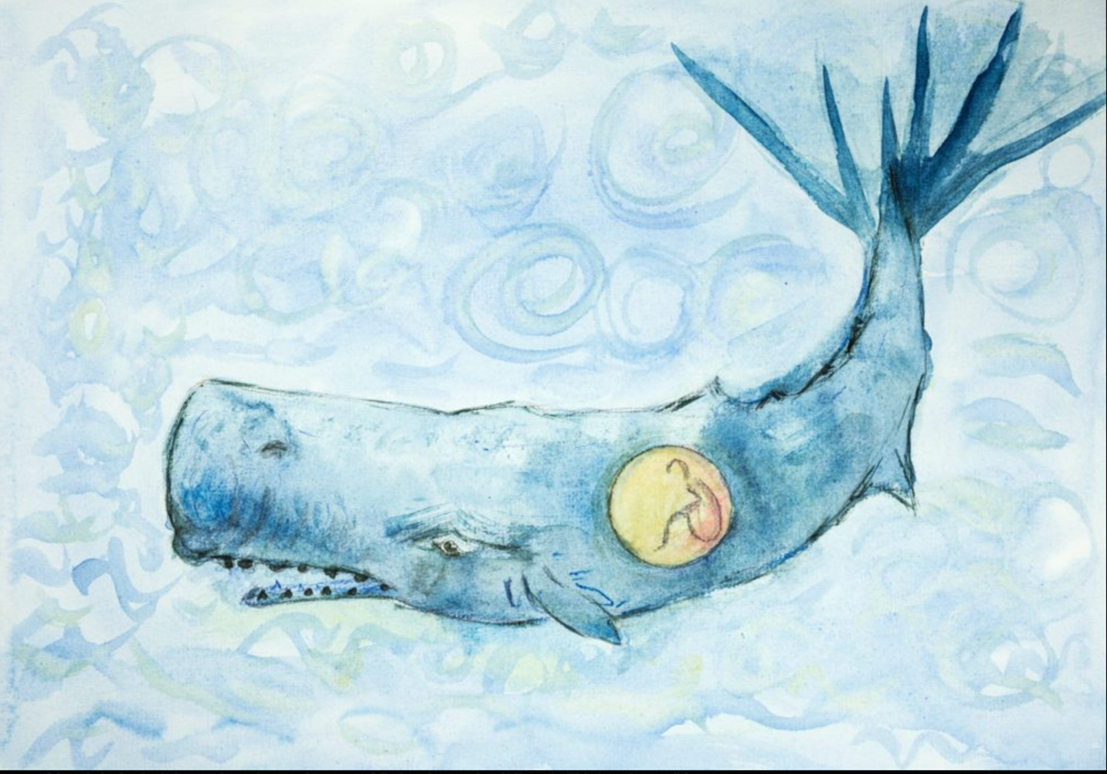
The big fish, it turns out, isn’t even MENTIONED in the poem of Chapter 2, where Jonah has gone down, down, down and “bottomed out”–not a big fish, but–in Sheol, the “Deep” or the Underworld. The big fish makes for a good children’s story, or bulletin cover art. And it’s central to Jonah’s plot, but not to Jonah’s theology, which seems to be something like: If you want to have spiritual clarity or transformation, you can’t be a “beautiful soul,” above it all. You may have to go down, first–to The Bottom of the Deep Blue Sea,8 down even to the belly (or womb!) of Sheol–before you can be reborn.9
Choose Your Own Adventure
There is a way–actually, a few ways–we can read Jonah like it is a straightforward story, not unlike we read Mark last year during Lent: beginning, middle, end. Moral lesson. Done. What’s interesting about Jonah, however, is that it’s actually more like a “Choose Your Own Adventure” novel, full of stopping points–each with their own kind of conflict and resolution–where you could end the story and walk away with very different takeaways.
“The Rescued Prophet”
Let’s say, for example, that we stopped at the end of Chapter 2. In this version of the story, Jonah flees his call, ends up in crisis, prays inside the big fish, and is rescued. We might call this telling “the OG Moby Dick” or “the Rescued Prophet” and in this reading of Jonah the central conflict is human against nature, or Jonah against the whale.10
For many Christians, this is THE STORY that matters: over time, Jonah’s three days in the fish’s belly came to correspond to the three days from the crucifixion to the resurrection. The big fish became a symbol for Christ’s tomb, “and Jonah’s reemergence from its belly was a foreshadowing of what gets told in the New Testament about the resurrection.”11 Jesus himself mentions this tradition in Matthew 12 in reference to the fate of the “Chosen One,” himself.
And this is likely the version that you grew up with. This is where a lot of illustrated children’s versions of the Bible end, for example. It’s personal; it’s really ONLY about Jonah’s private transformation. And this version is… fine. It’s SURPRISING (there’s a big fish!) but not really CONVINCING.12 The resolution is a little cliche. I already know that this version won’t preach to this congregation.
So, maybe it will be validating to you, like it was to me, to learn that some scholars think that Chapters 1 and 2 weren’t even in the original (which would mean that the big fish wasn’t in the original), with earlier chapters riffing off that poem and being added to “demonstrate that Jonah was an unwilling–and hence, sincere–prophet.”13 Following in the footsteps of his big brothers Moses, Isaiah, and Jeremiah, those… ahem… MAJOR prophets that I like to imagine Jonah had a kind of complex about.
“Mission Accomplished!”
OK. Let’s say we stopped at Chapter 3. In this version of the story, Jonah (reluctantly) goes to Nineveh and announces that the city is doomed: “Forty days from now and Nineveh will be overthrown” (Jonah 3:4). That is his big prophecy and–contrary to all expectations–he is taken seriously! The king and all his subjects and animals put on sackcloth and ashes, they fast, and they repent. (This is why, BTW, why Jonah is read on Yom Kippur, the Jewish Day of Atonement… even if, like Madi said, it’s a little ironic because the pagan sailors and Ninevites were actually better at repenting than Jonah). And… It works! God changes God’s mind–this is also part of Jonah’s theology, and it is good news–reverses the decree, and the city is saved. This one might be called, “Mission Accomplished.”
In this version of the story, the conflict is more human against human, Jonah against the Ninevites. Jesus actually references this version of the story in Matthew 12, too, praising the Ninevites for repenting, even as a MODEL of repentance that will condemn his own unbelieving generation at the judgment.
I think this version is SURPRISING, in its own way. It would be like activism that works. If Target or Enterprise, for example, just stopped allowing immigration enforcement actions on store property after single protests there.
I don’t know that it would have been CONVINCING, though, especially to contemporary listeners who would have just seen the fall of the Assyrian Empire and the destruction of the historical Nineveh… and, let’s be honest, who would probably have been pretty happy about it. I can just imagine contemporary listeners hearing Jonah and thinking, “that sound like a nice sentiment… good thing we don’t have to worry about it!”
It’s interesting here to contrast Jonah with another minor prophet who also predicts–this time accurately–that Nineveh will be destroyed, Nahum. There, we encounter a God who is ready to wreak violence against God’s enemies. “Nineveh has been devastated!” it reads, “Who will lament for her?” (Nahum 3:7).
That’s the version, for me at least, that–while not SURPRISING–is definitely more CONVINCING, and familiar even in how we talk about our own enemies. Just think about the ways some folks–even those with whom we likely share some political allegiance–talk about Luigi Mangioni as the Patron Saint of American Healthcare, or wish that the bullet that struck Donald Trump’s right ear had been a few inches to the left. OR THE WAY PETE HEGSETH BOASTS ABOUT “punching [Iran] while they’re down” and “winning decisively, devastatingly, and without mercy.”
For many, and it doesn’t really matter who you are, vengeance is more believable than mercy, and thank God(!) this isn’t where Jonah’s story ends.
God’s Complicated Ending
If you read all the way to the end, you find out that Jonah doesn’t feel vindicated when Nineveh repents, but betrayed by God for not destroying them. Now that’s SURPRISING. Just look at it from Jonah’s perspective, though: Here was his one shot for his prophecy to come true, to be a REAL (major?) prophet, and God’s mercy ruins his [admittedly 0-0] track record.
Of course, Jonah knows that God is “gracious and merciful, slow to anger, abounding in steadfast love, and ready to relent from punishment” (Jonah 4:2). He says so himself! He understands the concern that God has at the Ninevites’ possible destruction, and the joy that God feels at their repentance. AND he is human–that’s what I like about him. He’s petty and he resents God and he has a hard time accepting mercy… especially because it makes him look bad. And so he complains. It’s what makes his character “real” and the story CONVINCING.
By now, the conflict has turned inward: human against God, or human against self. Jonah’s heart needs help catching up to what he already knows in his head but doesn’t want to accept. And so God teaches him a few more lessons, or tries to: saving God’s creation is more important than a prophet’s (or even God’s!) reputation; prophecy isn’t about prediction, but MAKING A NEW FUTURE, starting with education and repentance; and that God is NOT harsh…. God RELENTS. And it’s good for us to do that, too.
–
Two weeks ago, Jo reminded us that in the story of Jonah, we are both the converted prophet and the Ninevites–citizens of Empire. And how righteous anger–if we don’t “nicey nice” away from it OR become consumed by it (because it is a CAGE)–can help us name and confront our enemies. It can hold them accountable WHILE we see the way they tell the truth about us, our communities, and the histories in which our lives are embedded.14 In the end, it’s not God’s mercy (or grace) against God’s justice, God’s mercy only works if it goes hand-in-hand with justice.
Chapter 4 of Jonah doesn’t come to any neat conclusions. Jonah is still angry. God is still patient. And the story ends with a question from God: ‘Can’t I pity Nineveh?’ We’re left sitting in the tension, as we are right now, in this very congregation.
Nobody likes where we are right now as a country, as a society. And we have this energy here to do something, but we don’t exactly know what. Some of us want action: a clear path, with bold steps forward. Others want mercy, or grace. Some want unequivocal change; others need space to lament and doubt. And I think that IF we are going to be faithful witnesses to the Biblical testimony of Jonah and others like him, THEN we need all of that. Jonah’s conflict is our own–the ambiguity, the call, the accountability, AND the challenge to mercy.
By Way of Conclusion
The question, “can’t I pity Nineveh,” never gets answered. We don’t know how Jonah responds, just as we sometimes don’t know how we will. Some of us might still be in the middle of the story somewhere! Maybe you are spiraling downward right now, or in the belly of the beast. We will walk with you there. Or maybe you just had your conversion experience. We will walk with you there. Maybe you are bitter. We will walk with you there, too.
Maybe… you are unapologetically a Ninevite! In which case, it’s a little weird you found yourself here, but you are welcome.
Being a community isn’t about always knowing which role we play, or always having pure motives. It’s about showing up–even as we wrestle with God’s question–together.
Amen.
Categories: talks
-
“How the Story of Jonah Works–A Writer Explains Jonah,” How Stories Work with Jay Sherer ↩
-
Maybe it’s like being a dwarf planet instead of a PLANET planet. We see you, Pluto. ↩
-
How to Read the Bible: A Guide to Scripture, Then and Now by James Kugel (p. 630) ↩
-
The Bible for Normal People (ep. 25) ↩
-
Don’t Put God in a Box, Unless You Want to Be Swallowed by a Fish ↩
-
These are all things scholars have debated about, going back at least to the late 11th century Rashi. ↩
-
Jonah for Normal People: A Guide to the Most Misunderstood Prophet of the Bible by Jared Byas (p. 26) ↩
-
“The Bottom of the Deep Blue Sea” by Missio ↩
-
Hegel (in Phenomenology of Spirit) characterized it as a “judging consciousness” that refuses to act in the “polluted” world, thereby failing to achieve true ethical reality. And THAT is good news (about the theology), I could end the sermon right there. ↩
-
The Making of a Story by Alice LaPlante (p.155) ↩
-
How to Read the Bible: A Guide to Scripture, Then and Now by James Kugel (p. 629) ↩
-
The Making of a Story by Alice LaPlante (p. 27) ↩
-
How to Read the Bible: A Guide to Scripture, Then and Now by James Kugel (p. 632) ↩
-
How to Have an Enemy by Melissa Florer-Bixler ↩